


Punjab—often referred to as the industrial heartland of India—is a global hub for heavy engineering and advanced machinery manufacturing. In the complex and highly specialized domain of Section Rolling Mill Plants, steel producers demand world-class precision, efficiency, and durability. For many, the search for a reliable machinery partner leads straight to this industrious state.
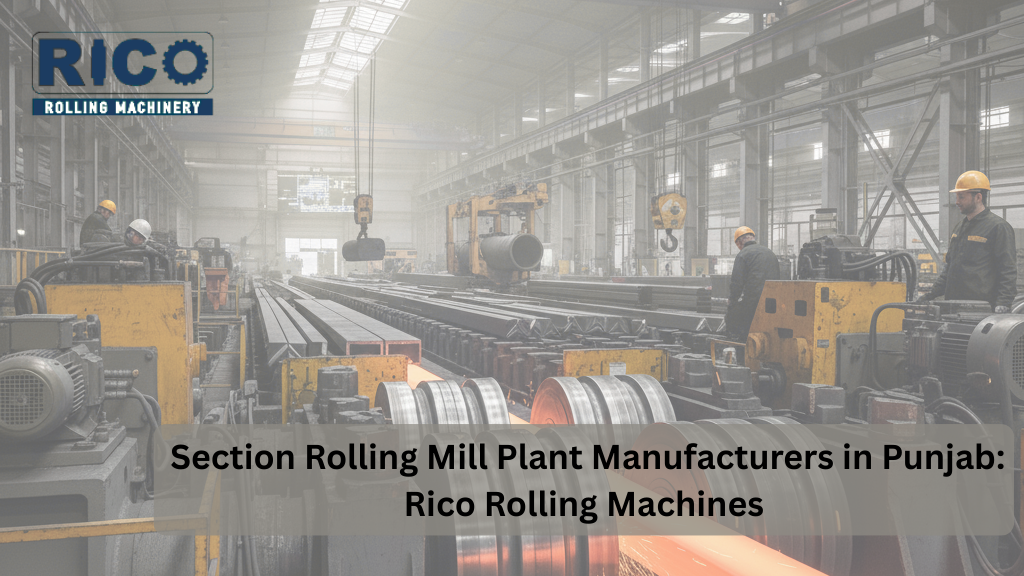
At Rolling Mill Machines, we take pride in being one of the premier Section Rolling Mill Plant Manufacturers in Punjab, combining decades of operational expertise with cutting-edge engineering innovation.
What Exactly Is a Section Rolling Mill Plant?
A Section Rolling Mill Plant is a large, sophisticated industrial facility designed to convert heated steel billets or blooms into finished structural steel products.
This is achieved through a controlled multi-stage rolling process in which the steel passes through a series of rolling stands. Each stand contains grooved rolls that progressively reduce the steel’s cross-section while shaping it into the desired profile. These final structural shapes include:
- Angles (L-beams)
- Channels (C-beams)
- Beams (I-beams or H-beams)
- Railway Rails
- Special Flat Bars and T-sections
In essence, a section mill transforms raw steel into the high-strength components that form the backbone of buildings, bridges, and infrastructure worldwide.
Understanding the Advantage of a Section Rolling Mill
1. High Dimensional Precision (Product Quality & Compliance)
- Explanation: Precision engineering in the mill’s design (rolls, stands, and control systems) guarantees that the final products—such as I-beams, H-beams, channels, and angles—meet strict national and international industry standards (e.g., precise web thickness, flange width, and straightness). This level of accuracy is mandatory for structural safety and ease of assembly in construction projects.
2. Enhanced Mechanical Properties (Product Strength & Integrity)
- Explanation: The controlled process of hot rolling, especially advanced techniques like Thermo-Mechanical Treatment (TMT) used in some mills, breaks down the coarse cast structure of the initial steel billet. This controlled deformation and subsequent cooling refine the material’s internal grain structure, making it more uniform and fine-grained. This results in superior properties like higher yield strength, better ductility, and reduced internal residual stresses.
3. Operational Cost Reduction (Efficiency & Profitability)
- Explanation: A well-built mill is engineered to minimize waste and maximize throughput:
- Energy Consumption: Modern, robust designs incorporate energy-efficient drives and thermal management, minimizing power usage per ton of steel produced.
- Material Wastage: High precision control reduces scrap rates and defective product batches.
- Faster Changeovers: Efficient roll-changing and automation features enable quicker size changeovers, drastically reducing non-productive downtime (NPT) and boosting overall output.
4. Increased Production Reliability (Output & Competitiveness)
- Explanation: A reliable mill is the backbone of the entire operation. Its robustness ensures consistent quality and performance across every production cycle, reducing the risk of unplanned breakdowns. By producing high-quality steel at a lower cost and a faster rate, the mill directly contributes to a steel producer’s ability to be profitable and competitive in the global market.
What Sets Our Plants Apart?
1. Customized Design & Engineering
Every mill we design is tailored to the client’s specific capacity and product mix. We specialize in:
- Continuous Section Mills
- Semi-continuous Mills
- Reversible Section Mills
This ensures maximum flexibility and high-tonnage performance.
2. Advanced Stand Configuration
Our plants incorporate state-of-the-art housingless, compact, or conventional rolling stands along with modern automation systems. The result is:
- Tight tolerance control
- Faster size changeovers
- Greater reliability
3. Integrated Automation
From furnace charging to the cooling bed and final bundling, our mills are equipped with:
- PLC-based control systems
- User-friendly HMI panels
- Precision drive systems
This ensures smooth operation, reduced downtime, and accurate diagnostics.
Why Punjab is Our Manufacturing Base
Our location in Punjab, the established nucleus of India’s heavy engineering sector, is not a coincidence—it’s a deliberate strategic choice that guarantees exceptional value and reliability for your investment. We seamlessly blend local manufacturing strengths with global quality standards, offering key competitive benefits:
- Engineering Excellence & Skilled Workforce: We draw directly from Punjab’s deep talent pool of seasoned engineers, fabricators, and specialized technicians. This ready access to a veteran workforce in rolling mill technology ensures that every phase, from detailed design to high-precision assembly, is executed with unmatched technical expertise and reliability.
- Optimized Supply Chain & Cost Control: The robust industrial ecosystem surrounding us provides immediate, highly competitive access to essential high-grade raw materials and specialized components. This strong, regionalized supply network significantly reduces procurement time and costs, allowing us to deliver durable, top-tier machinery at highly favorable prices.
- Seamless Global Logistics & Connectivity: Our manufacturing base benefits from superior transportation infrastructure, including extensive national highway access and major rail links. This positioning ensures expedited and secure shipment and installation of your heavy Section Rolling Mill Plant, whether your project is local, national, or export-bound.
Ready to Roll?
Whether you’re planning a new Section Rolling Mill project or upgrading an existing facility, partnering with the Leading Section Rolling Mill Plant Manufacturers in Punjab ensures advanced engineering and long-term reliability.
At Rolling Mill Machines, we deliver high-precision, durable, and efficient rolling mill plants tailored to your production needs. With customized engineering, strict quality control, and complete project support, we help you boost productivity and performance. Contact our team today at Rolling Mill Machines to discuss your requirements.
Frequently Asked Questions (FAQ)
Q1: What makes a Section Rolling Mill Plant different from a TMT or Bar Mill?
Ans. A Section Rolling Mill is designed for structural shapes with complex cross-sections (I-beams, channels, angles). TMT/Bar Mills primarily produce rebars and simpler round or square shapes.
Q2: Do you serve clients all over India?
Ans. Yes. While we are proud of our roots in Punjab, we provide complete engineering, manufacturing, installation, and commissioning services across the nation.
Q3: How important is automation in your Section Rolling Mills?
Ans. Automation is essential. Our PLC and HMI-integrated systems ensure high precision, reduced manpower, lower waste, and rapid size changes—directly enhancing operational profitability.
Q4: What is the typical lead time for a new plant?
Ans. Lead time varies based on production capacity and layout complexity (Continuous vs. Reversible). A detailed schedule is provided during the consultancy phase.
Q5: What is the typical lead time from order placement to final commissioning?
Ans: The lead time varies based on the complexity and scope of the mill (e.g., greenfield vs. upgrade). Generally, for a full-scale plant, it ranges from 12 to 18 months, covering design, manufacturing, shipment, and on-site commissioning. We provide a detailed project timeline upon contract signing.